
A Rs 60,000 Salary Costs Your Business Rs 69,000 — Here's the Full Breakdown
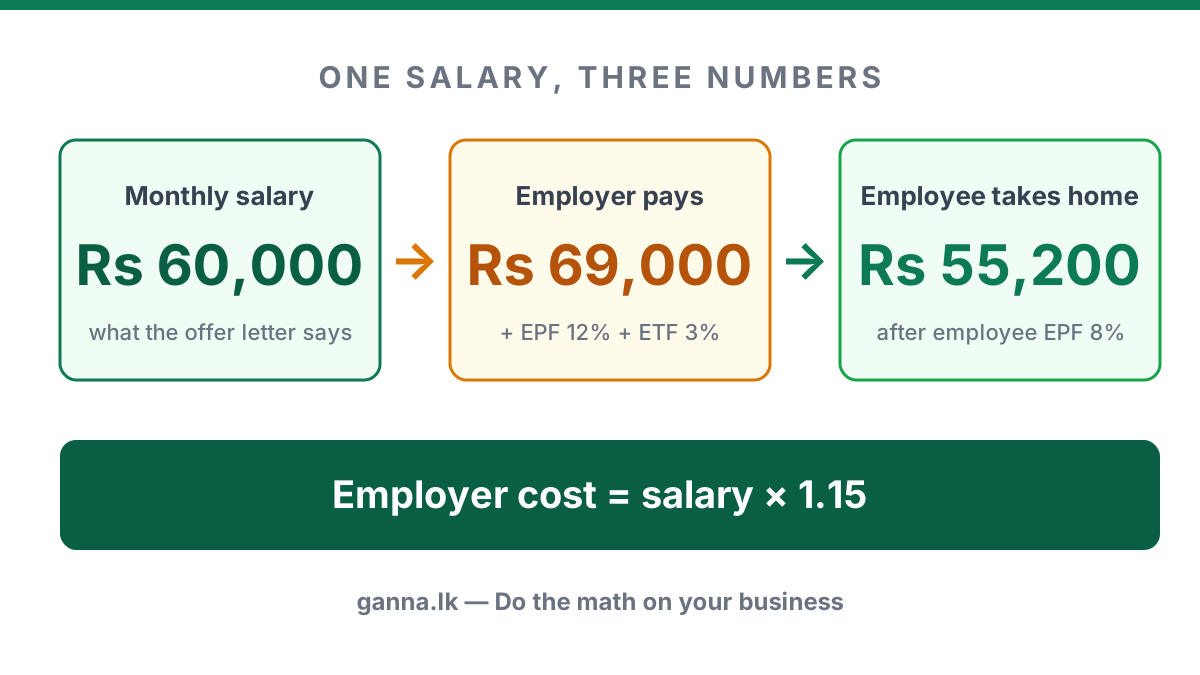
TL;DR: A Rs 60,000 monthly salary costs a Sri Lankan employer Rs 69,000 a month once the employer’s EPF (12%) and ETF (3%) contributions are added. The employee takes home Rs 55,200 after their own EPF (8%) is deducted — no APIT applies at this salary level. The rule of thumb: a salary costs the employer 1.15× its face value. Calculate any salary instantly →
Imagine you run a small repair shop in Moratuwa and you’re ready to hire your first assistant. You offer Rs 60,000 a month. Your budget spreadsheet says this hire costs you Rs 60,000 a month. It actually costs Rs 69,000. That missing Rs 9,000 is not anyone’s fault — it’s EPF and ETF, two contributions Sri Lankan law requires every employer to pay.
The breakdown (rupees per month)
| Basic salary | 60,000 |
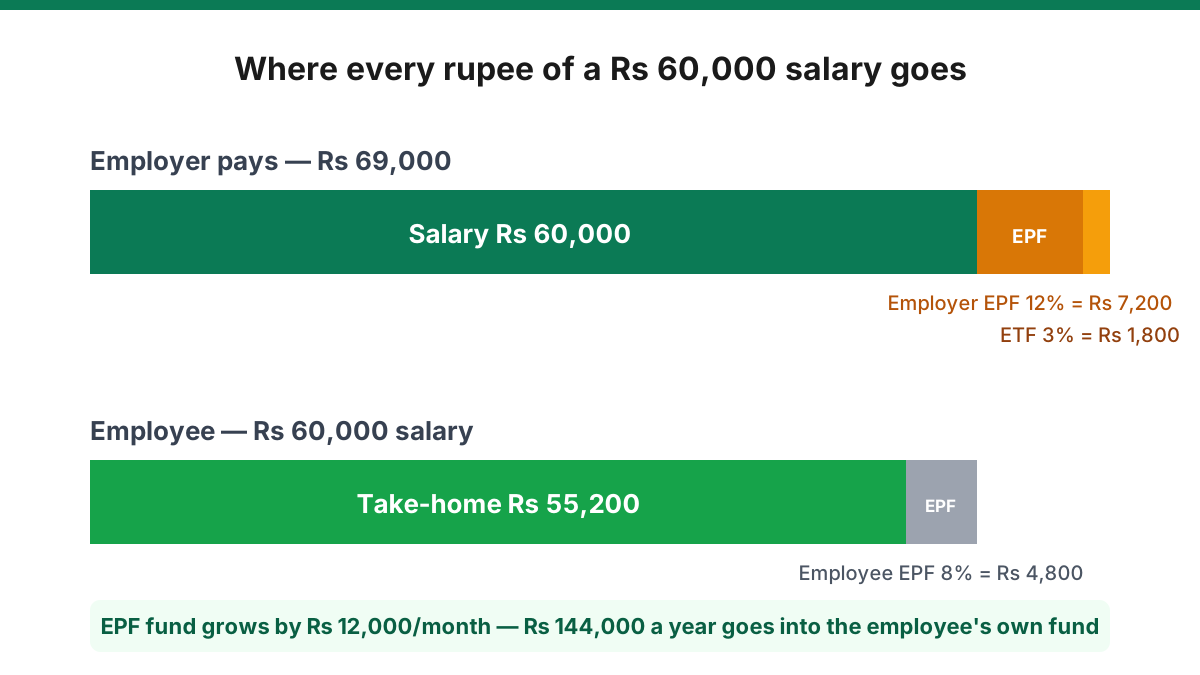
| Employer EPF contribution (12%) | 7,200 |
| Employer ETF contribution (3%) | 1,800 |
| Total employer cost | 69,000 |
| Employee EPF deducted (8%) | −4,800 |
| APIT (tax-free below Rs 100,000/month) | 0 |
| Employee take-home | 55,200 |
Annually: the employer spends Rs 828,000; the employee takes home Rs 662,400.
Where does the extra Rs 9,000 go?
- Rs 7,200 — Employer EPF (12%). This isn’t a tax. It goes into the employee’s own EPF account, on top of the Rs 4,800 deducted from their salary. So their EPF fund grows by Rs 12,000 a month (Rs 144,000 a year) — retirement money, not a loss.
- Rs 1,800 — Employer ETF (3%). Paid into the Employees’ Trust Fund. The employee claims this as a lump sum later when they leave (subject to ETF Board rules). The employee contributes nothing to ETF — it’s 100% employer money.
The mistake businesses make
Hiring managers budget “we can afford a Rs 60,000 hire” — then discover the real cost is Rs 69,000 a month, Rs 9,000 more than planned. Over a year that’s Rs 108,000 of unbudgeted cost per employee. Three hires at 60k = Rs 324,000 a year you never planned for.
The ×1.15 rule
Employer cost = salary × 1.15 (as long as there are no extra allowances). It works at every level: a Rs 100,000 salary costs Rs 115,000 (Rs 12,000 EPF + Rs 3,000 ETF), and the employee takes home Rs 92,000. Memorize 1.15 — it’s the fastest sanity check in Sri Lankan hiring.
Two things most people get wrong
- EPF/ETF are calculated on total earnings, not just the “basic salary.” If you pay allowances — cost of living, transport, attendance bonuses — they usually count toward the 12%/8%/3% base too. A “Rs 50,000 basic + Rs 10,000 allowances” deal has a bigger EPF bill than a flat Rs 60,000.
- The employer cannot deduct their own EPF/ETF share from your salary. The 12% + 3% sits on top of your agreed salary by law. If your payslip shows your salary reduced by 15% for “employer contributions,” something is wrong.
Frequently asked questions
How much is EPF and ETF on a Rs 60,000 salary?
Employer EPF: Rs 7,200 (12%). Employee EPF: Rs 4,800 (8%). Employer ETF: Rs 1,800 (3%). Total employer cost: Rs 69,000/month.
Does a Rs 60,000 salary pay APIT (income tax)?
No. A monthly salary of Rs 60,000 is below the APIT tax-free threshold, so APIT is Rs 0. Tax starts applying only above the monthly exempt amount (Table 01, 2025/26).
Can my employer deduct the employer’s EPF share from my salary?
No. The employer’s 12% EPF and 3% ETF are legally on top of your agreed salary. Only the employee’s 8% EPF is deducted from salary.
Is EPF calculated on basic salary or total earnings?
On total earnings — basic salary plus most allowances. This is why two employees with the same “basic” can have different EPF deductions.
How do I calculate the true cost of any salary?
Quick estimate: salary × 1.15 gives the employer cost (before any allowances). For an exact split — employer EPF/ETF, employee EPF, APIT, and take-home — use the free payroll calculator.
Sources
- Employees’ Provident Fund Act: employer contribution 12%, employee contribution 8% (Department of Labour)
- Employees’ Trust Fund Act: employer contribution 3% (ETF Board)
- APIT Tax Table No. 01, 2025/26 (Inland Revenue Department) — first monthly band tax-free
General information, not tax advice. Confirm specifics with your tax adviser or the Department of Labour.